source: American Chemical Society
Mostrando las entradas con la etiqueta ArmMorMtz. Mostrar todas las entradas
miércoles, 25 de abril de 2012
New plastic bleeds and heals like human skin
source: American Chemical Society
Reusable oil-absorbing nanosponges could soak up oil spills
Hashim shows off some of the nanosponge’s remarkable properties in the following video.
NT sponge soaks up oil
Buckyballs diet nearly doubles rats lifespan
A recent French study looking for chronic toxicity resulting from ingesting buckyballs dissolved in olive oil found that 10 month old rats who ingested the human equivalent of a tenth of a gram of C-60 buckyballs (which in technical grades cost less than US$10/gram) several times a week showed extended lifespans instead of toxic effects. All C-60-treated rats survived to at least 59 months, with the oldest surviving to 66 months. The control group lived for periods ranging from 17 months to 37 months, while an additional group fed only the extra olive oil lived for periods of 36 to 57 months. For the curious, the olive oil dosage was equivalent to a person adding about eight tablespoons of uncooked olive oil to their daily diet without compensating for the additional calories. Similar results have been reported for mammals held in a state of semi-starvation, but that is obviously not a pleasant lifestyle. All fullerenes are susceptible to clumping when dissolved in oil, so the preparation of the olive-oil/C-60 solution is rather lengthy. In these tests, 50 mg of C-60 buckyballs were added to 10 ml of virgin olive oil. These were stirred for two weeks at ambient temperatures with no incident light. Following the stirring, the solutions were centrifuged at 5,000 g for an hour. The fluid was separated from the precipitate, and was then passed through a 0.25 micron filter. The resulting liquid contained 0.8 mg/ml of C-60 buckyballs. The results beg the question - what is going on here? Is the life extension just for those lucky rats again, or is there a mechanism that might transfer over to humans? The study was aimed at discovering if a diet of buckyballs has any toxic effects, and the good news is that no toxicity was found. The buckyballs did move throughout the body (including the brain and central nervous system), and even enter individual cells. The ingested C-60 had an elimination half-life from blood of about 10 hours, so was essentially fully eliminated from the body within two days. It is not clear from the report if the C-60 was eliminated from intracellular fluid on that time scale. Specific studies of the effect of C-60 buckyballs on oxidative stress in the rats were performed by studying the effects of carbon tetrachloride (CCl4) injection. Carbon tetrachloride is well known to be poisonous to rats, being highly hepatotoxic (toxic to the liver). It is also associated with delirium and intoxication such as is experienced in the abuse of solvents. Rats which had been pretreated by water, by olive oil, and by olive oil containing C-60 buckyballs all showed typical signs of intoxication within a few minutes of CCl4 injection. However, while intoxication persisted in the water and olive oil groups for 24 hours, the olive oil and C-60 group emerged from intoxication after only five hours. In rats experiencing the pretreatment, but unexposed to carbon tetrachloride, autopsy revealed essentially normal livers. In those given a CCl4 injection, however, the livers from rats pretreated with water or olive oil showed important damage - a great deal of inflammation as well as large necrotic areas (dying or dead tissue). In contrast, the livers from rats pretreated with olive oil and C-60 buckyballs showed little damage or CCl4-induced cell death. Biochemical markers of liver damage showed far less elevation in the rats pretreated with olive oil and C-60. It does appear there is a real physiological effect on metabolic processes, and that oxidative stress in particular is significantly reduced in rats by chronic oral ingestion of an olive oil/C-60 solution. As oxidative stress is one of the factors usually associated with aging, there may well be a reasonable mechanism for the lifespan extension, especially if excess oxidation within individual cells is prevented by intracellular buckyballs. Will people react to a treatment of this sort with lifespans of 180-200 years? Only time will tell.
more @: http://www.gizmag.com/diet-buckyballs-extending-lifespan/22245/
lunes, 2 de abril de 2012
Construyen un “micrófono cuántico"
|
http://neofronteras.com/?p=3757
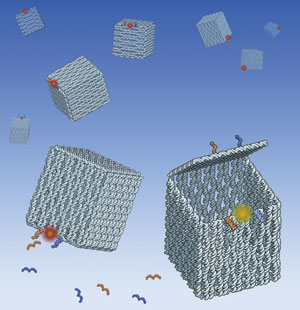
Nano-boxes from DNA origami
Jørgen Kjems, Kurt Gothelf and colleagues from Aarhus University, Denmark, have taken an existing technique known as 'DNA origami' into a whole new dimension. The technique traditionally uses a few hundred short DNA strands to staple longer DNA strands together to create two-dimensional nanostructures, usually building from a solid surface that supports the structures.
'But in this case you have things standing up,' says Kjems. 'And this makes the structures more fragile and much harder to image, so just to prove that you actually have your structure can be quite difficult,' he adds.
Read on:
Experimental demonstration of a single-molecule electric motor
For molecules to be used as components in molecular machines, methods that couple individual molecules to external energy sources and that selectively excite motion in a given direction are required. Significant progress has been made in the construction of molecular motors powered by light and by chemical reactions, but electrically driven motors have not yet been built, despite several theoretical proposals for such motors. Here we report that a butyl methyl sulphide molecule adsorbed on a copper surface can be operated as a single-molecule electric motor. Electrons from a scanning tunnelling microscope are used to drive the directional motion of the molecule in a two-terminal setup. Moreover, the temperature and electron flux can be adjusted to allow each rotational event to be monitored at the molecular scale in real time. The direction and rate of the rotation are related to the chiralities of both the molecule and the tip of the microscope (which serves as the electrode), illustrating the importance of the symmetry of the metal contacts in atomic-scale electrical devices.
single molecule rotors
A single-atom transistor
- Nature Nanotechnology (2012) doi:10.1038/nnano.2012.21
- Received 16 December 2011 |
- Accepted 26 January 2012 |
- Published online 19 February 2012
Abstract
The ability to control matter at the atomic scale and build devices with atomic precision is central to nanotechnology. The scanning tunnelling microscope can manipulate individual atoms and molecules on surfaces, but the manipulation of silicon to make atomic-scale logic circuits has been hampered by the covalent nature of its bonds. Resist-based strategies have allowed the formation of atomic-scale structures on silicon surfaces, but the fabrication of working devices—such as transistors with extremely short gate lengths, spin-based quantum computers and solitary dopant optoelectronic devices—requires the ability to position individual atoms in a silicon crystal with atomic precision. Here, we use a combination of scanning tunnelling microscopy and hydrogen-resist lithography to demonstrate a single-atom transistor in which an individual phosphorus dopant atom has been deterministically placed within an epitaxial silicon device architecture with a spatial accuracy of one lattice site. The transistor operates at liquid helium temperatures, and millikelvin electron transport measurements confirm the presence of discrete quantum levels in the energy spectrum of the phosphorus atom. We find a charging energy that is close to the bulk value, previously only observed by optical spectroscopy.
Whole article here:
Process Makes Polymers Truly Plastic
Richard Meritt. Just as a chameleon changes its color to blend in with its environment, Duke University engineers have demonstrated for the first time, that they can alter the texture of plastics on demand; for example, switching back and forth between a rough surface and a smooth one.
By applying specific voltages, the team has also shown that it can achieve this control over large and curved surface areas.
Keep on lecturing.
http://www.pratt.duke.edu/node/3244
Un tratamiento con nanopartículas mata células cancerígenas en media hora
El sistema, que ha sido probado con éxito en ratones, no daña las células sanas cercanas a los tumores tratados
Yaiza Martínez. Un equipo de científicos de la Universidad de Georgia, en Estados Unidos, ha utilizado nanopartículas y campos magnéticos alternantes para atacar las células cancerígenas de los tumores de cuello y cabeza de ratones. Los resultados obtenidos han revelado que este sistema puede matar las células cancerígenas en tan sólo media hora, sin que resulten dañadas las células sanas cercanas. El avance se suma a los de otras investigaciones que están constatando la utilidad de estas partículas microscópicas para tratar el cáncer. De hecho, las nanopartículas también pueden servir para llevar hasta los tumores medicamentos y allí suministrarlos, de manera muy selectiva.
Barrier to faster graphene devices identified and suppressed
These days, graphene is the rock star of materials science, but it has an Achilles heel: It is exceptionally sensitive to its electrical environment.
Vanderbilt University physicists report that they have nailed down the source of the interference inhibiting the rapid flow of electrons through graphene-based devices and found a way to suppress it.
click to open article
http://news.vanderbilt.edu/2012/03/faster-graphene
Plasmons resonate in atomic-scale metal particles
Addressing five decades of debate, Stanford engineers determine how collective electron oscillations, called plasmons, behave in individual metal particles as small as just a few nanometers in diameter. This knowledge may open up new avenues in nanotechnology ranging from solar catalysis to biomedical therapeutics.
http://engineering.stanford.edu/news/quantum-plasmons-demonstrated-atomic-scale-nanoparticles
San Francisco artist Kate Nichols creates structurally colored artwork using Surface Plasmon Resonances, the same phenomenon described by Scholl and Dionne. This image is a selected view from Nichols's two-part installation at The Leonardo Museum. Nature chose the same image to grace the cover of its issue featuring the Scholl/Koh/Dionne research. Credit: Kate Nichols. Through the Looking Glass 1. Silver nanoparticles on glass. 2011. In situ at The Leonardo Museum, Salt Lake City. Photo: Donald Felton/Almac Camera. www.katenicholsstudio.com
The physical phenomenon of plasmon resonances in small metal particles has been apparent for centuries. They are visible in the vibrant hues of the great stained-glass windows of the world. More recently, plasmon resonances have been used by engineers to develop new, light-activated cancer treatments and to enhance light absorption in photovoltaics and photocatalysis.
"The stained-glass windows of Notre Dame Cathedral and Stanford Chapel derive their color from metal nanoparticles embedded in the glass. When the windows are illuminated, the nanoparticles scatter specific colors depending on the particles' size and geometry " said Jennifer Dionne, an assistant professor of materials science and engineering at Stanford and the senior author of a new paper on plasmon resonances to be published in the journal Nature.
In the study, the team of engineers report the direct observation of plasmon resonances in individual metal particles measuring down to one nanometer in diameter, just a few atoms across.
"Plasmon resonances at these scales are poorly understood," said Jonathan Scholl, a doctoral candidate in Dionne's lab and first author of the paper. "So, this class of quantum-sized metal nanoparticles has gone largely under-utilized in engineering. Exploring their size-dependent nature could open up some interesting applications at the nanoscale."
The research could lead to novel electronic or photonic devices based on excitation and detection of plasmons in these extremely small particles, the engineers said.
"Alternatively, there could be opportunities in catalysis, quantum optics, and bio-imaging and therapeutics," added Dionne.
http://engineering.stanford.edu/news/quantum-plasmons-demonstrated-atomic-scale-nanoparticles
A Surprising New Kind of Proton Transfer
| Hydrogen bonds are ubiquitous but nowhere more important than in the structure of DNA and RNA, where they join the “stair-step” base pairs across the double strand. It has long been thought that protons transfer in molecules only by means of such hydrogen bonds. |
Read about it here:
http://newscenter.lbl.gov/news-releases/2012/03/18/proton-transfer/
South Pole Telescope Provides New Insights Into Dark Energy and Neutrinos
Neutrinos, the most abundant particles in the universe, until recently,
were thought to be without mass
South Pole Telescope findings are the most recent results produced by NSF-funded researchers. |
NSF-funded 10-meter South Pole Telescope in Antarctica provides new support for the most widely accepted explanation of dark energy, the source of the mysterious force that is responsible for the accelerating expansion of the universe.
Read whole article here:
Suscribirse a:
Entradas (Atom)