sábado, 14 de abril de 2012
Nanotechology with dna.. why not?
domingo, 8 de abril de 2012
Los retos para México en Nanociencia y Nanotecnología
México no está bien ubicado en ciencia a nivel internacional. De acuerdo con índices internacionales la realidad es clara, estamos muy por debajo de los países industrializados y también por debajo de países que están emergiendo como potencias científicas como China. Estos indicadores provienen del trabajo que se realiza en universidades y centros de investigación en todo el mundo, por lo que resulta necesario ubicar a las universidades y centros de investigación mexicanos a nivel internacional. México, país de 110 millones de habitantes, no puede tener ciencia competitiva con una sola universidad entre las primeras cien, la UNAM, y las demás instituciones científicas mexicanas en lugares muy por debajo. El reto de posicionar mejor las universidades del país implica cuando menos quintuplicar la producción científica, contratar más y mejores científicos (abrir muchas más plazas), crear instituciones de investigación de excelencia, invertir no sólo más en ciencia sino también en educación superior y en todo el sistema educativo mexicano. Lo anterior requiere mucho más del tan comentado 1% del Producto Interno Bruto (PIB) para la ciencia.
Con estos antecedentes, pese a lo novedoso de la Nanociencia y Nanotecnología (NyN), la situación de este campo en México no es muy diferente a lo expuesto. México se encuentra en el lugar 24 en publicaciones de NyN con 518 artículos en 2005. En los primeros lugares están Estados Unidos con 14 mil 750 publicaciones, China con 11 mil 746, Japón con 7 mil 971, Alemania con 5 mil 665, Corea del Sur con 4 mil 98, Francia con 3 mil 994, el Reino Unido con 2 mil 786, etc. En el mismo artículo, México no aparece en la lista de países con patentes relacionadas con NyN. Para lograr un número de publicación similar al del Reino Unido (séptimo lugar), México requiere quintuplicar su producción científica y para estar en tercer lugar con Japón requeriría 15 veces en NyN. Todo esto sin considerar otro factor importante, pobremente considerado en el país, la vinculación con la industria, la innovación y la competitividad. Ciertamente, con las prioridades bien enfocadas y los mecanismos adecuados del gobierno, la NyN pueden ayudar a mejorar la competitividad de México a través de innovación, lo cual no se ve por ningún lado, todavía.
La NyN pueden ser un nicho para que se comiencen a dar desarrollos que ayuden a paliar la situación tan penosa de la balanza tecnológica. De lo anterior se desprende otro reto para el país y para el desarrollo de NyN: la articulación entre las universidades y el sector productivo. En los países industrializados se alienta que los investigadores formen empresas de México esto no ocurre, se da de manera que no impacta o definitivamente se desalienta. Hay que recordar que las universidades y los centros de investigación al mismo tiempo tienen que mejorar su lugar en producción científica y tecnológica para demostrar a las empresas que hay posibilidades de éxito. Pocos empresarios, nacionales o internacionales, invertirán recursos en universidades nacionales que se encuentran en los sitios 1000 de la tabla mencionada anteriormente.
Para mejorar la situación de la NyN, la ciencia, la tecnología, la innovación y la vinculación, México no sólo requiere invertir el 1% del PIB en ciencia y seguir la ley: se requieren varias reformas estructurales entre las que están una reforma integral en educación, incluyendo por supuesto la educación superior, y se requiere una reforma en ciencia y tecnología. No hay otra manera de poder enfrentar los retos futuros ni de apoyar el desarrollo del país. De seguir así, no vamos a subir de los lugares 30 en ciencia, pero seguro sí bajará en la tabla y se dejará poco margen de maniobra para que las generaciones futuras salgan adelante.
En lo personal, y teniendo en mente lo mencionado en este artículo, debo comentar que el grupo de investigación en NyN al que pertenecíamos no sólo mi hermano Mauricio y yo, sino estudiantes y técnicos en el IPICYT (centro del Conacyt), de acuerdo a un artículo publicado en la revista internacional Physica Status Solidi B en 2008, estaba ubicado en el lugar número 10 a nivel mundial. Digo estaba, porque ha sido destruido por la misma dirección del IPICYT y del mismo Conacyt.
*Profesor visitante en la Universidad Católica de Lovaina en Bélgica y en el Laboratorio Nacional de Oak Ridge en Estados Unidos · hterrones007@gmail.com
sábado, 7 de abril de 2012
Nanotecnologia y.. esperen que? Petroleo?
ORNL's Bobby Sumpter was part of a multi-institutional research team that set out to grow large clumps of nanotubes by selectively substituting boron atoms into the otherwise pure carbon lattice. Sumpter and Vincent Meunier, now of Rensselaer Polytechnic Institute, conducted simulations on supercomputers, including Jaguar at ORNL's Leadership Computing Facility, to understand how the addition of boron would affect the carbon nanotube structure.
"Any time you put a different atom inside the hexagonal carbon lattice, which is a chicken wire-like network, you disrupt that network because those atoms don't necessarily want to be part of the chicken wire structure," Sumpter said. "Boron has a different number of valence electrons, which results in curvature changes that trigger a different type of growth."
Simulations and lab experiments showed that the addition of boron atoms encouraged the formation of so-called "elbow" junctions that help the nanotubes grow into a 3-D network. The team's results are published in Nature Scientific Reports.
Fuente:
http://www.nanotech-now.com/news.cgi?story_id=45121
Islamic Azad University - Omidieh Branch, Omidieh, Iran
jueves, 5 de abril de 2012
Nano-scale fuel cells may be closer
To compress more power into smaller volumes, researchers have begun to build fuel cells on the fuzzy frontier of nanotechnology. Silicon etching, evaporation, and other processes borrowed from chip manufacturers have been used to create tightly packed channel arrays to guide the flow of fuel through the cell. The point is to pack a large catalytic surface area into a wafer-thin volume. This approach is not only expensive, but inherently limited by its two-dimensional nature.

A polymer-electrolyte membrane (PEM) fuel cell generates current by stripping
Researchers Kenneth Lux and Karien Rodriguez, at the University of Wisconson, came up with an exciting new approach to the problem. Their method not only improves the performance of nano-scale fuel cells, but completely sidesteps the need for industrial-strength technology. “Even the best electrocatalysts, on a flat surface, give only hundreds of microamps per square centimeter. What you really want is … to increase the surface area by orders of magnitude.” Lux explains to PhysOrg.com, “To do this you need a three-dimensional structure.”
http://www.physorg.com/news11654.html
Id 140414
miércoles, 4 de abril de 2012
Drug -Delivering Robot
Back in 1966, a science fiction movie called Fantastic Voyage wowed audiences as a submarine was miniaturized and injected into a human vein. The concept seemed unbelievable, like something you’d see in a children’s cartoon, which we actually did see in the popular kids’ show Magic School Bus. But 45 years after the film came out, it appears that something similar is actually happening in the world of nanorobotics that could change the way eye surgery is performed in the future.
A team at the Swiss Federal Institute of Technology in Zurich led by Brad Nelson, professor of Robotics and Intelligent Systems, have created a microbot tiny enough to be injected into an eye without the need for any anesthetic. Nelson said in a video interview (shown below) that the first applications are in targeted delivery. Diseases like age-related macular degeneration, which is the leading cause of blindness in older people, or retinal vein occlusions, can be treated with the microbot by delivering the drugs to a specific location on the retina.
Right now, the most common treatment for macular degeneration is a drug that is injected into the eye. It tends to diffuse quickly through the retina, so it requires regular injections. The robot, on the other hand, can stay in the eye for months, so it could provide a lengthier and more-targeted drug release. The robot can also position a biodegradable drug capsule in the eye and then be removed with a magnetic needle.
Basically a tiny magnet, the microbot is controlled by an electromagnetic field outside of the eye. Nelson said they have to be very precise about controlling the fields and the currents through their electric magnets. This has been a challenge that the team has been able to overcome in the past couple of years.
The research has been done on synthetic eyes, or the eyes of dead animals so far. The eye in the video below is that of a pig. The team says it will be moving soon to the eyes of living animals, which will be followed by human trials.
Nelson said that if they can make it small enough to fit in a 23 gauge needle, it can be injected into the eye with just topical anesthetic or none at all, and it doesn’t even need a suture. Though the microbot still has a ways to go before it can be used regularly on (live) humans, the tiny size of the robots could bring forth a new type of non-invasive surgery.
DNA reference tags allow single-molecule research on complex genomes
By Itza Montforte, web writer
Yuval Ebenstein, a scientist whose previous work was on Quantum dots light up individual DNA binding proteins recently shown that proteins bound to DNA can be located very accurately by direct imaging. The precision of the measurement presents new opportunities for contextual genomic research on the single-molecule level. It was also improved the dependance on the ends of the DNA for mapping. On earlier works, the DNA used was simply the one of viruses and bacterias while this new technology alows to work on more complex genomes such as the human genome.
In order to do this, the scientists use an enzime to attach a biotin to specific sequences in a vial genome, then quantum dots are sent to attach on the biotin and create a fluorescence along the genome. All this to accurately map the positions of individual RNA polumerases sitting on the genome and labeled with quantum dots of different color.
Quoting the author of this experiment. "As a single molecule approach we hope to be able to detect very rare genomic configurations that are usually hidden in the noise of conventional bulk methods for mapping DNA binding proteins. This could have impact in diagnostics and personalized medicine."
To read more about "Quantum dots light up individual DNA binding proteins" please visit:
http://www.nanowerk.com/spotlight/spotid=10701.php
To read more about this work by Yuval Ebenstein please visit:
http://www.nanowerk.com/spotlight/spotid=24557.php?utm_source=feedburner&utm_medium=twitter&utm_campaign=Feed%3A+nanowerk%2FagWB+%28Nanowerk+Nanotechnology+News%29
3D printer with nanoscale precision
By Itza Montforte Noguez, Web writer
By using a new technology calles "two-photon lithography" Now it is possible to print three dimensional objects with incredibly fine details.
This technology allows the fabrication of tiny structures on a nanomether scale. This new technology also improves the speed on the process opening new areas of application.
The 3D printer uses a liquid resin hardened at precise spots with a laser beam. The focal point is guided through the resin by moveble mirrors. The speed on this technique increased from a few millimeters per second to five meters per second. A new world record to this technique.
At he University of Technology Vienna (where this technique was developed) scientists are now developing bio-compatible resins for medical applications. They can be used to create scaffolds to which living cells can attach themselves facilitating the creation of biological tissue.
http://www.nanowerk.com/news/newsid=24553.php?utm_source=feedburner&utm_medium=twitter&utm_campaign=Feed%3A+nanowerk%2FagWB+%28Nanowerk+Nanotechnology+News%29
martes, 3 de abril de 2012
Molecular Heat pump for electric cars
By Itza Montforte Noguez, web writer.
USA, Pacific Northwet National Laboratory.
This laboratory is working on nanotechnology that would extend the range of electric cars by allowing them to heat and cool the passenger cabins with a new type of heat pump. The final goal is to create electric cars that are more affordable to operate.
This work is inspired by the final goal of having 1 millions electric cares on the road by the year 2015. The problem with current electric vehicles, powered entirely by electricity is that they are limited by the power-storage capacity of their lithium-ion bateries. The design proposed is for a new type of heat pump that would require far less power to heat and cool a car, extending battery charce and range.
The design is based on metallic organic frameworks (MOFs) which are formed out of metal ions bound to organic compounds, nanotechnology improvements. MOFs are porous and can be calibrated to cause various chemical elemts to bind with them in controlled ways to that they can control de condensation and evaporation of the refrigeant, heating or cooling air delivered to the car's interior.
The researcher wanto to creat a new, 5-pound molecular heat pump, that sice of a 2-liter bottle that would handle both heating and cooling and allow the cars to travel longer distances before they need to be plugged in again.
To read more about this work by the Pacific Northwest National Laboratory please visit:
http://seattletimes.nwsource.com/html/localnews/2017720051_electriccars11.html?syndication=rss
Renewable Hydrogen through Nanotechnology
lunes, 2 de abril de 2012
Construyen un “micrófono cuántico"
|
http://neofronteras.com/?p=3757
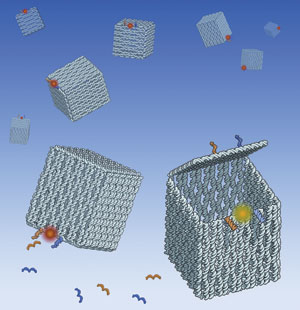
Nano-boxes from DNA origami
Experimental demonstration of a single-molecule electric motor
A single-atom transistor
- Nature Nanotechnology (2012) doi:10.1038/nnano.2012.21
- Received 16 December 2011 |
- Accepted 26 January 2012 |
- Published online 19 February 2012
Abstract
Process Makes Polymers Truly Plastic
Richard Meritt. Just as a chameleon changes its color to blend in with its environment, Duke University engineers have demonstrated for the first time, that they can alter the texture of plastics on demand; for example, switching back and forth between a rough surface and a smooth one.
By applying specific voltages, the team has also shown that it can achieve this control over large and curved surface areas.
Keep on lecturing.
http://www.pratt.duke.edu/node/3244
Un tratamiento con nanopartículas mata células cancerígenas en media hora
El sistema, que ha sido probado con éxito en ratones, no daña las células sanas cercanas a los tumores tratados
Yaiza Martínez. Un equipo de científicos de la Universidad de Georgia, en Estados Unidos, ha utilizado nanopartículas y campos magnéticos alternantes para atacar las células cancerígenas de los tumores de cuello y cabeza de ratones. Los resultados obtenidos han revelado que este sistema puede matar las células cancerígenas en tan sólo media hora, sin que resulten dañadas las células sanas cercanas. El avance se suma a los de otras investigaciones que están constatando la utilidad de estas partículas microscópicas para tratar el cáncer. De hecho, las nanopartículas también pueden servir para llevar hasta los tumores medicamentos y allí suministrarlos, de manera muy selectiva.
Barrier to faster graphene devices identified and suppressed
These days, graphene is the rock star of materials science, but it has an Achilles heel: It is exceptionally sensitive to its electrical environment.
Vanderbilt University physicists report that they have nailed down the source of the interference inhibiting the rapid flow of electrons through graphene-based devices and found a way to suppress it.
click to open article
http://news.vanderbilt.edu/2012/03/faster-graphene
Plasmons resonate in atomic-scale metal particles
http://engineering.stanford.edu/news/quantum-plasmons-demonstrated-atomic-scale-nanoparticles
A Surprising New Kind of Proton Transfer
| Hydrogen bonds are ubiquitous but nowhere more important than in the structure of DNA and RNA, where they join the “stair-step” base pairs across the double strand. It has long been thought that protons transfer in molecules only by means of such hydrogen bonds. |
Read about it here:
http://newscenter.lbl.gov/news-releases/2012/03/18/proton-transfer/
South Pole Telescope Provides New Insights Into Dark Energy and Neutrinos
South Pole Telescope findings are the most recent results produced by NSF-funded researchers. |
domingo, 1 de abril de 2012
DNA Immobilization and Detection on Cellulose Paper using a Surface Grown Cationic Polymer via ATRPS
Synthesis of well-defined polymeric structures using ATRPS has been reported in a number of early publications. This method is robust and versatile in its capability to yield controlled chain growth and to achieve many different forms of polymers, including hyperbranched polymers, star-shaped polymers, and block copolymers. Moreover, several groups have recently reported the use of ATRP method for the “grafting from” of polymer brushes which have great potential in fabrication of medical devices and surface-modified nanoparticles. Compared to the “grafting through” method, “grafting from” polymerizations result in brush copolymers with high molecular weight side chains. In addition, this approach does not require the synthesis of a macromonomer, which is the most difficult step in the “grafting through” process.
The detection of nucleic acids in various solutions, including complex biological environments, has been the focus of many research groups who are trying to develop fast and reliable detection mechanisms of nucleic acid based disease biomarkers. Among the most significant nucleic acid biomarkers that have recently been discovered are microRNAs. The develop- ment of simple and effective diagnostic devices based on disease biomarkers such as microRNAs, DNA fragments and proteins have excelled in recent years. The detection of nucleic acids in solution provides simplicity but lacks the specificity and sensitivity offered by traditional surface based assays especially with regards to detection in complex biological environments, such as serum or blood. Aied etl al. presents a way to make the detection of DNA hybridization with out modifying the sample in any way. This system is capable of identifying DNA hybridization in serum on the basis of a combination of mechanisms omposed of polymer- ssDNA probe interaction, ssDNA-cDNA (cDNA) hybridization and finally, PicoGreen intercalation. By fluorescence they were able to identify DNA hybridization.
The full text can be found in
Ahmed Aied, Yu Zheng. DNA Immobilization and Detection on Cellulosa Paper using a Surface Grown Cationic Polymer via ATRP. ACS: Applied Material & Interfaces. 4. 2012. 826-831.