Mostrando las entradas con la etiqueta 145728. Mostrar todas las entradas

viernes, 30 de noviembre de 2012

Avances en tratamientos del cáncer.

Metal nanoparticles may improve cancer treatment.
November 30, 2012 

Metal nanoparticles may improve cancer treatment


The research team developed a detector to measure the radiation dose in three dimensions. Research led by RMIT University has shown that cheap, non-toxic nanoparticles can enhance radiotherapy treatments for cancer. An international team of researchers led by RMIT has investigated alternatives to gold nanoparticles, which have been shown to concentrate radiation used to treat cancer but are highly expensive and mildly toxic. Doctoral researcher Mamdooh Alqathami said the team had identified bismuth as an ideal option, with tests showing that enhancing radiotherapy by using nanoparticles containing the heavy metal almost doubled the dose of radiation to surrounding cancerous tissue. "By enhancing radiation in the tumour, doctors may be able to decrease the initial dose of radiotherapy, which will hopefully result in fewer side effects for the patient while having the same impact on the cancer," Mr Alqathami, a researcher in the School of Medical Sciences, said. "Metal nanoparticles have shown promise in improving the efficacy of radiotherapy but there is a need to find cheaper and safer alternatives for therapeutic use. "Bismuth-based nanoparticles are an attractive option as they cost only a few dollars per gram, compared with thousands of dollars a gram for gold, and they are non-toxic, reducing any side effects from potential treatments. "While further work needs to be done before our findings can be implemented into conventional cancer treatments, this is an exciting advance that gives us a promising focus for ongoing research." Mr Alqathami collaborated with researchers from RMIT's Health Innovations Research Institute, the University of Melbourne, the University of Surrey (UK) and the Institute of Cancer Research (UK) on the study. To test the efficacy of bismuth, Mr Alqathami placed the nanoparticles inside a detector developed by his team to measure the radiation dose in three dimensions. The sample and detector was exposed to radiation that would normally be used to treat cancers. The final dose delivered was then compared with normal treatments, showing the bismuth-based nanoparticles increased the radiation dose by 90 per cent. The team is planning further tests to validate the findings and fully understand the dosage increase, to enable the findings to be implemented in cancer treatment. This research was presented at the International Conference on 3D Radiation Dosimetery recently held in Sydney. Provided by RMIT University 

Fullerenos como contenedores


Molecules ‘quantum rattle’ in buckyball cage

"Under these conditions, the confined molecules reveal a wave-like nature and behave according to the laws of quantum mechanics," says University of Southampton Professor Malcolm Levitt. "Apart from their intrinsic interest, we expect that the special properties of these materials will lead to a variety of applications, such as new ways to brighten the images of MRI scans, and new types of computer memory."Photo by: Credit: Hajv1/Wikimedia Commons
The nano-meter sized cavity of the hollow spherical C60 Buckminsterfullerene—or buckyball—effectively creates a “nanolaboratory,” allowing detailed study of the quantum mechanical principles that determine the motion of the caged molecule, including the mysterious wave-like behavior that is a fundamental property of all matter.
Experiments by the international team of researchers, including physicists from the University of Nottingham, have revealed the wave-like behavior and show how the imprisoned H2 and H2O molecules ‘quantum rattle’ in their cage.

Straight from the Source

DOI: 10.1073/pnas.1210790109
Professor Tony Horsewill of the School of Physics and Astronomy says: “For me a lot of the motivation for carrying out this investigation came from the sheer pleasure of studying such a unique and beautiful molecule and teasing out the fascinating insights it gave into the fundamentals of quantum molecular dynamics. Intellectually, it’s been hugely enjoyable.
“However, as with any blue-skies research initiative there is always the promise of new, often unforeseen, applications. Indeed, in the case of water molecules inside buckyballs we have a guest molecule that possesses an electric dipole moment and the collaboration is already investigating its use in molecular electronics, including as an innovative component of a molecular transistor.”
The research has recently been published in Proceedings of the National Academy of Sciences.
The discovery of the C60 Buckminsterfullerene, and the related class of molecules the fullerenes, in the mid-1980s earned Professors Harry Kroto, Robert Curl, and the late Richard Smalley the Nobel Prize in Chemistry in 1996.
It has a cage-like spherical structure made up from 20 hexagons and 12 pentagons and resembles a soccer ball, earning it the nickname “buckyball.”
Molecular surgery
In a recent breakthrough in synthetic chemistry, Japanese scientists from Kyoto have invented a molecular surgery technique allowing them to successfully permanently seal small molecules such as H2 and H2O inside C60.
They used a set of surgical synthetic procedures on the C60 “cage” that produced an opening large enough to “push” an H2 or H2O molecule inside at high temperature and pressure. The system was then cooled down to stabilize the entrapped molecule inside and the cage was surgically repaired to reproduce a C60.
Horsewill adds: “This technique succeeds in combining perhaps the universe’s most beautiful molecule C60 with its simplest.”
The Nottingham research group has employed a technique called inelastic neutron scattering (INS) where a beam of neutrons—fundamental particles that make up the atomic nucleus—is used to investigate the “cage rattling” motion of the guest molecules within the C60.
Their investigations have given an insight into the wavelike nature of H20 and H2 molecules and their orbital and rotational motion as they move within the C60.
New types of water
Professor Malcolm Levitt, of the School of Chemistry at the University of Southampton, who has used the technique nuclear magnetic resonance (NMR) to study the quantum properties of the caged molecules, says: “By confining small molecules such as water in fullerene cages we provide the controlled environment of a laboratory but on the scale of about one nanometer.
“Under these conditions, the confined molecules reveal a wave-like nature and behave according to the laws of quantum mechanics. Apart from their intrinsic interest, we expect that the special properties of these materials will lead to a variety of applications, such as new ways to brighten the images of MRI scans, and new types of computer memory.”
The paper also separately identifies two subtly different forms of H2O—ortho-water and para-water. These so called nuclear spin-isomers also owe their separate identities to quantum mechanical principles.
Researchers from Brown University, as well as scientists in Japan, France, Estonia, and the UK contributed to the findings.

Pesar moléculas individualmente.


‘Nanobridge’ weighs molecules one by one

This scanning electron micrograph shows one of the molecule-weighing devices. The bridge-like section at the center vibrates sideways. The scale bar at the bottom is two microns.Photo by: Credit:Scott Kelberg and Michael Roukes/Caltech
Researchers say the new technology will eventually help doctors diagnose diseases, enable biologists to study viruses, probe the molecular machinery of cells, and even allow scientists to better measure nanoparticles and air pollution.
Described in the journal Nature Nanotechnology, the device—which is only a couple millionths of a meter in size—consists of a tiny, vibrating bridge-like structure. When a particle or molecule lands on the bridge, its mass changes the oscillating frequency in a way that reveals how much the particle weighs.
“As each particle comes in, we can measure its mass,” says Michael Roukes, professor of physics, applied physics, and bioengineering at California Institute of Technology (Caltech). “Nobody’s ever done this before.”
The new instrument is based on a technique Roukes and his colleagues developed over the last 12 years. In work published in 2009, they showed that a bridge-like device—called a nanoelectromechanical system (NEMS) resonator—could indeed measure the masses of individual particles, which were sprayed onto the apparatus.
The difficulty, however, was that the measured shifts in frequencies depended not only on the particle’s actual mass, but also on where the particle landed. Without knowing the particle’s landing site, the researchers had to analyze measurements of about 500 identical particles in order to pinpoint its mass.
But with the new and improved technique, the scientists need only one particle to make a measurement. “The critical advance that we’ve made in this current work is that it now allows us to weigh molecules—one by one—as they come in,” Roukes says.
To do so, the researchers analyzed how a particle shifts the bridge’s vibrating frequency. All oscillatory motion is composed of so-called vibrational modes. If the bridge just shook in the first mode, it would sway side to side, with the center of the structure moving the most.
The second vibrational mode is at a higher frequency, in which half of the bridge moves sideways in one direction as the other half goes in the opposite direction, forming an oscillating S-shaped wave that spans the length of the bridge. There is a third mode, a fourth mode, and so on. Whenever the bridge oscillates, its motion can be described as a mixture of these vibrational modes.
The team found that by looking at how the first two modes change frequencies when a particle lands, they could determine the particle’s mass and position, explains Mehmet Selim Hanay, a postdoctoral researcher in Roukes’s lab and first author of the paper.
“With each measurement we can determine the mass of the particle, which wasn’t possible in mechanical structures before.”
Traditionally, molecules are weighed using a method called mass spectroscopy, in which tens of millions of molecules are ionized—so that they attain an electrical charge—and then interact with an electromagnetic field. By analyzing this interaction, scientists can deduce the mass of the molecules.
The problem with this method is that it does not work well for more massive particles—like proteins or viruses—which have a harder time gaining an electrical charge. As a result, their interactions with electromagnetic fields are too weak for the instrument to make sufficiently accurate measurements.
The new device, on the other hand, does work well for large particles. In fact, the researchers say, it can be integrated with existing commercial instruments to expand their capabilities, allowing them to measure a wider range of masses.
The researchers demonstrated how their new tool works by weighing a molecule called immunoglobulin M (IgM), an antibody produced by immune cells in the blood. By weighing each molecule—which can take on different structures with different masses in the body—the researchers were able to count and identify the various types of IgM.
Medical uses
Not only was this the first time a biological molecule was weighed using a nanomechanical device, but the demonstration also served as a direct step toward biomedical applications. Future instruments could be used to monitor a patient’s immune system or even diagnose immunological diseases. For example, a certain ratio of IgM molecules is a signature of a type of cancer called Waldenström macroglobulinemia.
In the more distant future, the new instrument could give biologists a view into the molecular machinery of a cell. Proteins drive nearly all of a cell’s functions, and their specific tasks depend on what sort of molecular structures attach to them—thereby adding more heft to the protein—during a process called posttranslational modification.
By weighing each protein in a cell at various times, biologists would now be able to get a detailed snapshot of what each protein is doing at that particular moment in time.
Another advantage of the new device is that it is made using standard, semiconductor fabrication techniques, making it easy to mass-produce. That’s crucial, since instruments that are efficient enough for doctors or biologists to use will need arrays of hundreds to tens of thousands of these bridges working in parallel.
“With the incorporation of the devices that are made by techniques for large-scale integration, we’re well on our way to creating such instruments,” Roukes says. This new technology, the researchers say, will enable the development of a new generation of mass-spectrometry instruments.
The team includes researchers from the Kavli Nanoscience Institute at Caltech and Commissariat à l’Energie Atomique et aux Energies Alternatives, Laboratoire d’électronique des technologies de l’information (CEA-LETI) in Grenoble, France.
Support was provided by the Kavli Nanoscience Institute, the National Institutes of Health, the National Science Foundation, the Fondation pour la Recherche et l’Enseignement Superieur from the Institut Merieux, the Partnership University Fund of the French Embassy to the USA, an NIH Director’s Pioneer Award, the Agence Nationale pour la Recherche through the Carnot funding scheme, a Chaire d’Excellence from Fondation Nanosciences, and European Union CEA Eurotalent Fellowships.
Source: Caltech

miércoles, 31 de octubre de 2012

Nanopartículas con droga directamente al mitocondria


Nanopartículas con droga directamente al mitocondria

Posibles resultados alentadores para cáncer, obesidad y Alzheimer.
Sistema de suministro de droga vía nanopartículas directamente hasta el mitocondria.  (crédito: S. Marrache et al./PNAS)
Sistema de suministro de droga vía nanopartículas directamente hasta el mitocondria. (crédito: S. Marrache et al./PNAS)
Investigadores de la Universidad de Georgia han afinado el proceso de suministro de nanopartículas de droga a orgánulos específicos dentro de la célula.
Al tener como objetivo a los mitocondrias, que suministran la mayor parte de energía para la actividad celular, los investigadores incrementaron la efectividad de las terapias utilizadas para el tratamiento del cáncer, la enfermedad de Alzheimer y obesidad en estudios realizados con células cultivadas.
“Los mitocondrias son un orgánulo complejo que es muy difícil de alcanzar, pero estas nanopartículas están elaboradas de manera que puedan realizar bien su trabajo en el lugar correcto”, indicóShanta Dhar, profesor del Franklin College de la Universidad de Georgia.
Dhar y Sean Marrache utilizaron un polímero biodegradable aprobado por la FDA para fabricar sus nanopartículas y luego las usaron para encapsular y probar drogas que se utilizan contra varios tipos de enfermedades. El resultado obtenido fue publicado a principios de esta semana en Proceedings of the National Academy of Sciences.
Para probar la efectividad de su sistema de suministro de droga contra el cáncer, encapsularon lonidamine, que funciona en base a inhibir la producción de energía en el mitocondria y, separadamente, una forma de la antioxidante vitamina E. Suministraron su carga a las células cultivadas y descubrieron que el tener como objetivo al mitocondria se incrementaba la efectividad de las drogas en más de 100 veces comparado con la droga sola y 5 veces más comparado con otros métodos de nanopartículas que tienen como objetivo la parte externa de la célula.
De manera similar, el compuesto curcumin  mostró una gran promesa al inhibir la formación de placas amiloides que son la huella de la enfermedad de Alzheimer, pero rápidamente se degrada en la presencia de luz y se deshace en el cuerpo. Al encapsular curcumin en nanopartículas con objetivo directo el mitocondria, los investigadores pudieron restablecer en las células cerebrales cultivadas la habilidad de sobrevivir a pesar de la presencia de un compuesto que alentaba la formación de placas amiloides. Cerca del 100 por ciento de las células tratadas con nanopartículas direccionadas al mitocondria sobrevivieron en la presencia del compuesto alentador de placas, comparado con el 67 por ciento de sobrevivencia con curcumin libre y 70 por ciento con otros tratamientos de nanopartículas fuera de las células.
Finalmente, los investigadores encapsularon la droga 2,4-DNP contra la obesidad -que hace la producción de energía en el mitocondria menos eficiente- y al aplicarla notaron que reduce la producción de grasa en las células cultivadas conocidas como preadipocytes en un 67 por ciento comparado con el suministro de la droga sola, y un 61 por ciento comparado con otros tratamientos con nanopartículas que tienen como objetivo el exterior de la célula.
“Muchas enfermedades están asociadas con un mitocondria disfuncional, pero muchas de las drogas que actúan sobre el mitocondria no pueden alcanzarlo”, indicó Marrache. “En lugar de tratar de alterar la droga, que puede reducir su efectividad, la encapsulamos en estas nanopartículas y la suministramos directamente donde se requiere: el mitocondria”.
Más información aquí.

Tratamiento con nanopartículas de oro para cáncer de próstata


Tratamiento con nanopartículas de oro para cáncer de próstata

Este nuevo tratamiento puede tener menos efectos colaterales que la terapia tradicional para este cáncer.
Científicos de la Universidad de Missouri han probado un nuevo tratamiento contra el cáncer de próstata utilizando nanopartículas de oro radioactivo (crédito: University of Missouri)
Científicos de la Universidad de Missouri han probado que su nuevo tratamiento contra el cáncer de próstata utilizando nanopartículas de oro radioactivo es seguro para utilizarse en perros.
Sandra Axiak-Bechtel, del Colegio de Medicina Veterinaria de esta universidad, dijo que este es un gran paso para la investigación utilizando nanopartículas de oro.
En la actualidad, grandes cantidades de quimioterapia son requeridas cuando se trata ciertos tipos de cáncer, con el resultado de efectos colaterales tóxicos. Los químicos entran en el cuerpo y trabajan para disminuir el tumor, pero incluso ocasional daño a órganos vitales y reducen drásticamente las funciones corporales.
Este es un gran paso para obtener la autorización de realizar pruebas clínicas en humanos, dijo Axiak-Bechtel. “Los perros desarrollan cáncer de próstata de manera natural de manera similar a los humanos, por lo que el tratamiento con nanopartículas de oro tiene gran posibilidad de aplicarse bien en los humanos”.
Kattesh Katti ha encontrado una manera más eficiente de aplicar nanopartículas de oro en tumores prostáticos. Este nuevo tratamiento requiere dosis que son miles de veces más pequeñas que la quimioterapia y no viaja a través del cuerpo ocasionando daño en áreas saludables.
“Obtuvimos resultados asombrosos en ratones que mostraron una reducción significativa en el volumen del tumor a través de inyecciones de nanopartículas de oro radioactivo”, indicó Katti. “Estos hallazgos han conformado un fundamento sólido y esperamos trasladar este tratamiento novedoso a terapias para tratamientos en humanos”.
“El aplicar este tratamiento a perros ha sido muy útil, ya que los perros desarrollan estos tumores de manera natural. Ya que perros no pueden indicar como se sienten, la mayoría de veces la detección de esta enfermedad se realiza demasiado tarde; este tratamiento nos da la esperanza de poder combatir tumores muy agresivos”.
Más información aquí.

Nueva marca: 100,000 fotones entrelazados detectados


Nueva marca: 100,000 fotones entrelazados detectados

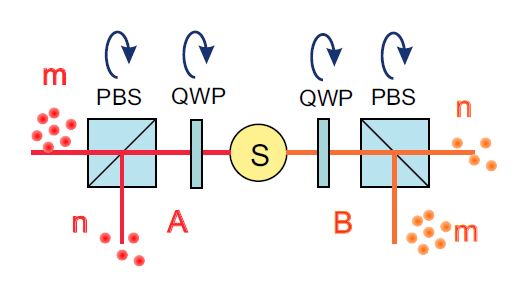
Correlaciones cuánticas en un estado de Bell simple. La fuente S emite pulsos de luz en los rayos A y B (separados espacialmente para más claridad). En cada pulso, el número de fotones emitidos en modo de polarización ortogonal en los dos rayos son aleatorios pero exactamente iguales (Crédito: Timur Sh. Iskhakov et al.)
Una asombrosa marca de 100,000 fotones entrelazados han sido detectados por vez primera, dejando atrás la marca anterior de solamente 12 fotones.
Esta técnica podría resultar muy segura para compartir claves en comunicaciones encriptadas.
Los fotones entrelazados tienen estados cuánticos ligados, de manera que la medición de un fotón determina el estado del otro, sin importar la distancia que los separa.
La detección del entrelazado de manera general requiere la coincidencia de la medición -la detección simultanea de fotones múltiples en el mismo estado cuántico en lugares distintos. Pero estos detectores no son lo suficientemente sensibles para ordenar las partículas entrelazadas de las no entrelazadas cuando se tiene un gran número de fotones.
Los investigadores hicieron un disparo láser a través de un dispositivo conocido como separador de rayo polarizado, el cual crea dos rayos de fotones con distintas polarizaciones. Los rayos se envían a través de un par de cristales de bario para generar fotones con la misma polarización pero distintas longitudes de onda. Estos rayos se recombinan posteriormente para crear pulsos de luz, y cada pulso de luz consta de 100,000 fotones.
El equipo separa cada pulso una vez más en rayos con dos distintas polarizaciones y luego utiliza detectores para contar el número de fotones en cada rayo y calcula la diferencia. Los valores que el equipo midió fueron consistentes con el entrelazamiento.
Más información aquí.

viernes, 28 de septiembre de 2012

Cubierta de nanoparticulas en papel


Waterproof Paper Paper doped with nanoparticles is rendered antimicrobial, waterproof and even magnetic. IIT
A nanoparticle spray can turn regular paper into superpaper, rendering it waterproof, antimicrobial, magnetic and probably very expensive. Who said paper was an old technology?
Scientists at the Istituto Italiano di Tecnologia in Genoa, Italy, developed a process to cover any cellulose fiber, like paper or fabric, with a reactive coating. It involves combining the fiber molecules with a nanoparticle solution, creating a polymer matrix.

The cellulose fibers are wetted with an acrylic solution containing manganese ferrite nanoparticles, which are magnetic. When it gets wet, the mixture forms a nano-shell around each individual fiber, rendering the fiber water-repellent. Scientists can change the composition of the nanoparticles to make it more or less magnetically responsive, or to add other attributes, like perhaps fluorescence. Add some colloidal silver, and it could be antibacterial.

Aside from the small nano-shell around each of the fibers, the paper’s properties don’t change — you could still print with it, fold it, mail it or whatever you want, as Forbes explains. The paper could have a wide range of applications, from foodpackaging and medical documents to secure bank notes. Waterproof paper could be used to protect valuable documents, according to Roberto Cingolani, scientific director at the IIT.
The superpaper is described in the Journal of Materials Chemistry.
[Forbes via Wired UK]

El grafeno es capaz de repararse así mismo


Graphene Holes A hole in graphene ... the hole being repaired ... and the hole fully healed. Novoselov et al./arXiv.org
Once punctured by wayward metal atoms, the wonder material graphene can stitch itself back together, healing over with a new patch of two-dimensional carbon atoms. This new finding sheds more light on the strange properties of graphene, and it could even lead to new graphene creation strategies.
Graphene is an atom-thick layer of bonded carbon atoms, and as we’ve seen time and again, it has several special electrical and chemical abilities that place it at the center of future technologies. But it’s a tricky beast. It can’t be arranged simply in a lab — it must be grown just so — and it’s highly reactive with other compounds, including itself. It readily curls up into a cylinder, forming the carbon nanotubes of so many nanoscale experiments. This means it’s difficult to produce graphene in large quantities, as Technology Review's arXiv blog notes.

But ripping a hole in it and letting the graphene fix itself could be one new trick. The graphene sheetjust needs a supply of loose carbon atoms it can use to form the patch.

Konstantin Novoselov at the University of Manchester and colleagues — who, by the way, are joint recipients of the Nobel Prize in 2010 for graphene — used a beam of electrons to etch some holes into a graphene sheet. They doped the hole with palladium and nickel atoms, which ensure that the hole will form (electrons alone would not be enough, for atomic reasons we won’t get into here). They added still more transition-metal atoms to make the hole bigger, and took images of the injured graphene sheet using an electron microscope.
If there were some extra carbon atoms around, the graphene sheet would snatch them up and use them to displace the metal atoms, forming new carbon-carbon bonds at the hole. If the carbon exists in hydrocarbon form — a compound of hydrogen and carbon — then the patch won’t be perfect. But if the atoms are pure free carbon, the graphene will stitch itself together by forming more pure graphene.
The last finding is important for future graphene growth, because it suggests that the shape and size of graphene sheets can be controlled with foreign metals and a free-carbon reservoir. Plus it’s interesting to know that graphene, along with all its other strange and useful properties, can heal itself.
Novoselov and colleagues posted a manuscript describing this work on the arXiv preprint server.

domingo, 23 de septiembre de 2012

Nano hair


El nuevo Nano pelo, lo que busca ser una posible solucion a la calvicie sin embargo Los hombres que son completamente calvos no pueden usarlo porque las microfibras de Keratina, (que es como pelo cortado en mil pedazos) no tienen en qué adherirse, pero a aquellos que todavía les quedan algunos mechones pueden aplicárselo. Por lo que cuenta con muchas limitaciones.

sábado, 1 de septiembre de 2012

Avance en Nanobots


Investigadores del Instituto de tecnologia de California y las Universidades de Columbia y Arizona han conseguido construir y programar dos "robots moleculares" (entre cuyos componentes se ha insertado ADN) capaces de realizar tareas complejas a una escala microscópica. Los robots, igual que sus parientes de mayor tamaño, pueden moverse, pararse, girar y realizar con precisión los trabajos para los que están programados. En un artículo publicado hace unos días en Nature, los autores explican cómo estos "nanobots" están destinados, en apenas unos años, a revolucionar por completo una multitud de áreas, desde la ingeniería industrial a la medicina.
El primero de los dos robots es una especie de "araña molecular" que, según la programación que incorpore, será capaz incluso de tomar sus propias decisiones y reaccionar de acuerdo con el ambiente en el que se encuentre. Sus tres patas son enzimas de ADN que son capaces, por ejemplo, de dividir una secuencia genética determinada o de ensamblar todo tipo de moléculas construyendo (o rompiendo) sus enlaces moleculares.
El segundo robot es una especie de cadena de montaje de apenas unos nanómetros de tamaño (un nanómetro es la milmillonésima parte de un metro). Tiene cuatro patas y tres manos, es capaz de desplazarse rápidamente por un sustrato de ADN y, a partir de las nanopartículas que se le suministren, está diseñado para ensamblar cualquier clase de material imaginable, incluso nuevos materiales diseñados en laboratorio.
Materiales inimaginables
Ambos ingenios constituyen un paso decisivo hacia la construcción de legiones de "microrobots de ADN" capaces de fabricar, en potencia, cualquier clase de dispositivo, tanto eléctrico como mecánico. Su capacidad para ensamblar moléculas de una forma que era imposible hasta ahora será decisiva, opinan los investigadores, para diseñar y fabricar nuevos materiales que hasta ahora sólo estaban en la imaginación de los científicos.
Hasta ahora, sólo había sido posible construir nanobots capaces de realizar tareas muy sencillas, como la de desplazarse. A partir de ahora, se podrá además dotar a estas micromáquinas de una programación concreta para desempeñar labores específicas, e incluso dotarlas de la capacidad de decidir por sí mismas entre un gran número de acciones. Los nanobots podrán, por ejemplo, repararse o reconstruirse a sí mismos, o decidir si la célula que tienen enfrente es cancerosa y debe por tanto ser destruida.
Aplicaciones infinitas
"Un robot - afirma Erik Winfree, profesor de ciencias computacionales del Caltech- es una máquina que percibe su entorno, toma una decisión y después actúa en consecuencia". Igual que sus "colegas" en las grandes cadenas de montaje, estos microrobots a escala molecular podrán llevar al terreno de los microscópico todas las ventajas de la robótica moderna. Con el añadido de que serán capaces de trabajar indistintamente con o sobre materiales orgánicos o inorgánicos. O lo que es igual, podrán construir o reparar tanto componentes eléctricos como tejidos vivos.

Las aplicaciones para esta clase de máquinas de ADN son infinitas y abarcan una gran multitud de campos. Todo depende de la programación que incorporen. Una legión de nanobots inyectada en el cuerpo de un astronauta podría, por ejemplo, mantenerlo sano y en forma durante un largo viaje espacial. Otro "miniejército" mecánico podría combatir, desde dentro, un tumor, a base de perseguir y destruir todas las células cancerosas que encuentre en el organismo.
Creo que este descubrimiento tiene posibilidades infinitas ya que aunque sean simples robots a escalas moleculares sus posibles usos son infinitos ya sea para bien o para mal, sin embargo depende de los visionarios hacer un buen uso de ellos.
Juan Ramon Narváez Monroy